
Histoplasma yeasts and Leishmania amastigotes look alike in a marrow aspirate, but their treatment is completely different. Six features that separate them, a third mimic to remember, and exam MCQs.

- Single best clue: a rod-shaped kinetoplast beside the nucleus means Leishmania
- Histoplasma: yeast with a clear halo, crescent-shaped nucleus and narrow-based budding; GMS and PAS positive
- Leishmania: amastigote with nucleus and kinetoplast; GMS and PAS negative; CD1a positive
- Background: Leishmania often brings plasmacytosis and haemophagocytosis
- Why it matters: antifungals for Histoplasma; antimonials or amphotericin B regimens for Leishmania
Six features side by side
| Feature | Histoplasma (yeast) | Leishmania (amastigote) |
|---|---|---|
| Location | Almost always inside macrophages | Inside macrophages and free in the smear from ruptured cells |
| Internal structure | Crescent-shaped, eccentric nucleus; no kinetoplast | Round nucleus plus a small rod-shaped kinetoplast (mitochondrial DNA) |
| Outline | Clear halo (retracted cytoplasm, a pseudocapsule); narrow-based budding | No halo, no budding |
| Size | About 2–4 µm | About 1–4 µm |
| Special stains | GMS and PAS positive | GMS and PAS negative; CD1a positive by immunohistochemistry |
| Background | Often sparse inflammation; granulomas in immunocompetent hosts | Plasmacytosis, haemophagocytosis and hypergammaglobulinaemia |
The plasma cell-rich marrow of visceral leishmaniasis can be mistaken for myeloma or an autoimmune disease. When you see marked plasmacytosis with hepatosplenomegaly and pancytopenia, search the macrophages carefully.
Image guide


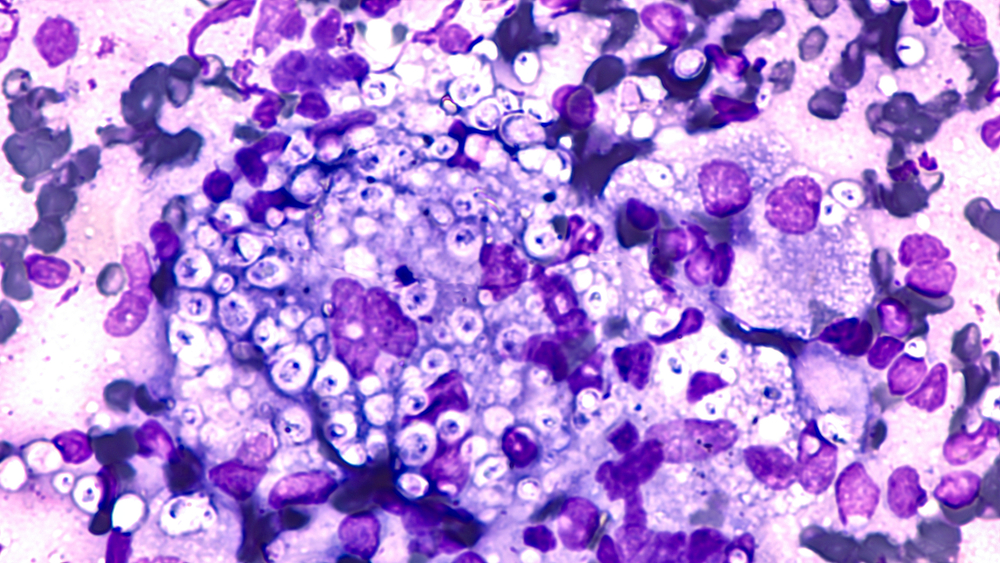


A third mimic: Talaromyces
Talaromyces (formerly Penicillium) marneffei, seen in immunosuppressed patients from South and Southeast Asia including north-east India, also forms small intracellular yeasts. It divides by fission, so look for a transverse septum rather than budding; it is GMS and PAS positive.
Kinetoplast means Leishmania; a halo with budding means Histoplasma; a central septum means Talaromyces. Toxoplasma tachyzoites and Cryptococcus (larger, with a thick mucicarmine-positive capsule) are the other usual distractors.
Practice questions
Marrow macrophages contain 2–3 µm organisms, each with a round nucleus and a small rod-shaped structure beside it. What is the organism?
Show answer
Which stain result favours Histoplasma over Leishmania?
Show answer
Small intracellular yeasts dividing by a transverse septum in an HIV-positive patient from north-east India suggest:
Show answer
- Kinetoplast means Leishmania.
- Halo, crescent nucleus and budding mean Histoplasma; it is GMS and PAS positive.
- Leishmania is GMS and PAS negative and CD1a positive, with plasmacytosis.
- Remember Talaromyces: septum, not budding.
Bain BJ, Clark DM, Wilkins BS. Bone Marrow Pathology, 5th ed. Wiley-Blackwell; 2019 · Procop GW, Pritt BS, eds. Pathology of Infectious Diseases. Elsevier; 2015 · Bain BJ. Blood Cells: A Practical Guide, 6th ed. Wiley-Blackwell; 2022
High-Yield, Board-Style Image MCQs & Interactive Whole Slide Images
High-resolution virtual microscopy with questions aligned to ABP, FRCPath, NEET-SS, DM Hematopathology and MD/DNB.


Leave a Reply