
Watch the video completely
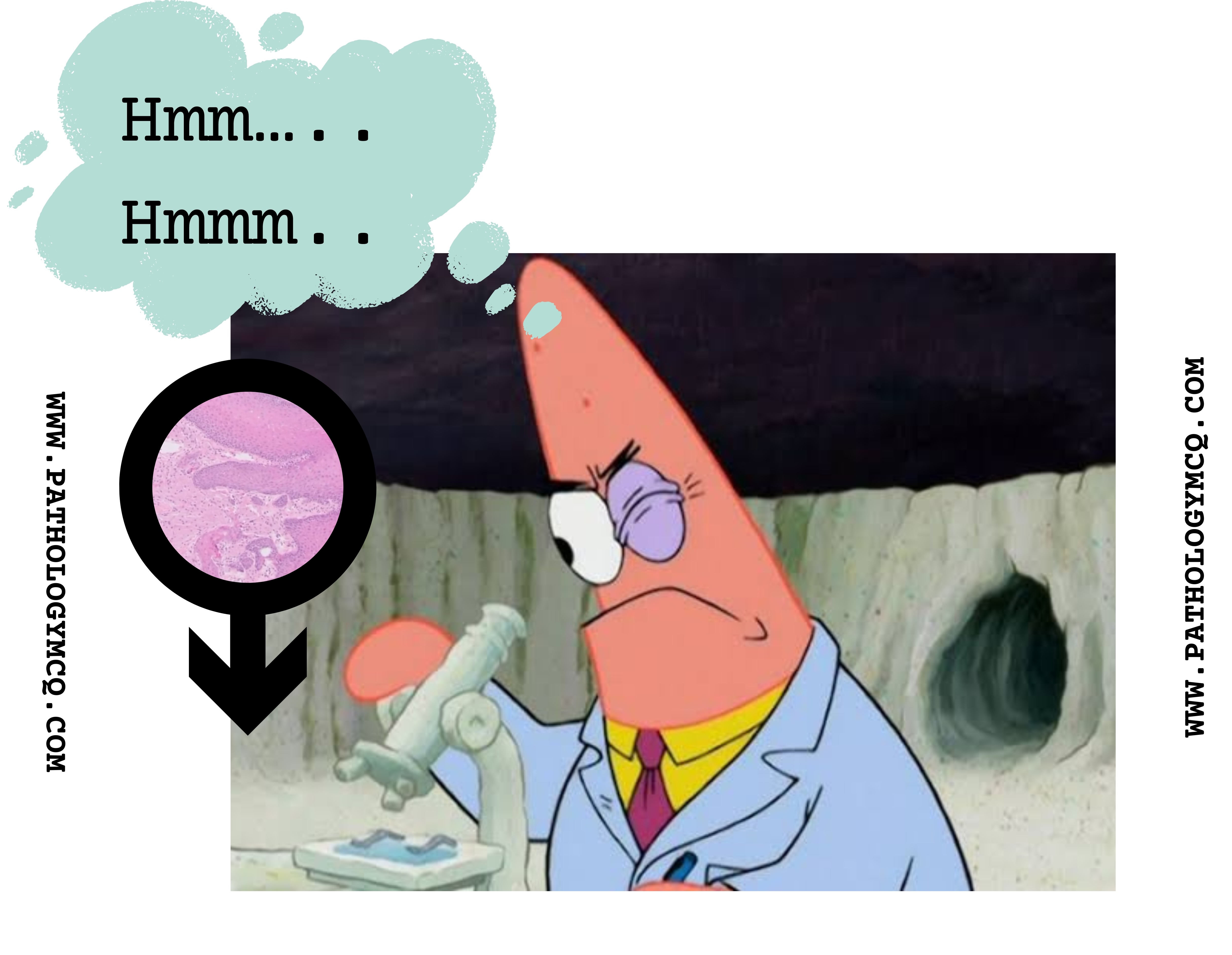
How to differentiate between squamous cell carcinoma and pseudoepitheliomatous hyperplasia (PEH)?

Questions to ask:
- Is the orientation proper- if not, consider reorienting.
- Is proper clinical history available- get clinical history especially in difficult cases
Suspect pseudo-epitheliomatous hyperplasia when
- You see elongation of epithelium, interconnected rete-ridges (these may simulate pseudo invasion) In the absence of significant atypia
- When prominent lymphocytic or neutrophilic inflammatory infiltrates are identified. (suspect infectious etiologic in these cases)

Role of IHC: Studied to distinguish between invasion and pseudo invasion. p53 shows diffuse nuclear positivity in tumor cells (true invasion) whereas negative in PEH. E-cadherin is lost in tumor cells whereas intact in PEH.
Conditions associated with PEH.: Granular cell tumor, Candidiasis (median rhomboid glossitis, chronic hyperplastic candidiasis), Necrotizing sialometaplasia , Deep chronic infections, such as blastomycosis , Granulomatosis with polyangiitis , Oral submucous fibrosis, Melanocytic nevi, Melanoma.
Do add your own tips in the comments below.
References:
- Cooper, P. H. (2005). Distinguishing Pseudoepitheliomatous Hyperplasia from Squamous Cell Carcinoma in Cutaneous Lesions. Archives of Pathology & Laboratory Medicine, 129(8), 1032-1036. https://doi.org/10.5858/2005-129-1032-DPHFSC
- Kodet, O., Lacina, L., Krejčí, E., Dvořánková, B., Smetana, K., & Matoušková, E. (2015). Pseudoepitheliomatous hyperplasia: Review. International Journal of Clinical and Experimental Pathology, 8(7), 8580-8585. https://www.ncbi.nlm.nih.gov/pmc/articles/PMC4589711/
- Santoro, A., Pannone, G., Contaldo, M., Pagliuca, M. Q., Serpico, R., & Maiorano, E. (2015). Pseudoepitheliomatous hyperplasia: A misleading mimic of squamous cell carcinoma. International Journal of Surgical Pathology, 23(2), 110-115. https://doi.org/10.1177/1066896914566834


Leave a Reply